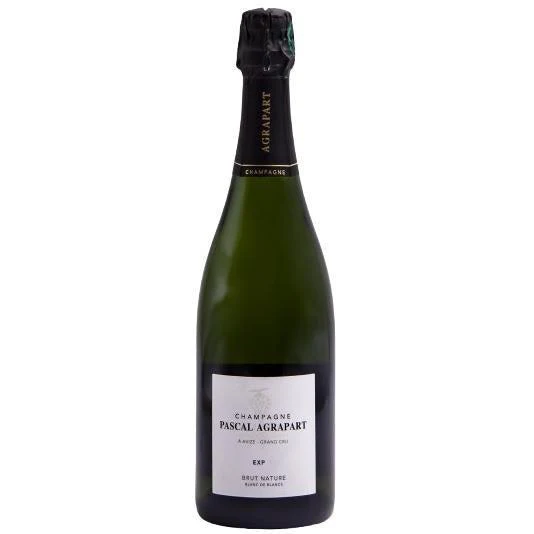
Champagne Pascal Agrapart Grand Cru EXP Blanc de Blancs 2019 (Disg. Jul 24)
Disgorged July 2024. (Formerly known as Expérience). The price here reflects the demand for a cuvée that is utterly unique in the Champagne world and the rarity (there is next to none to go around). Finally, we should not forget that this is a wine style that is extremely difficult to make.
First, some background for those new to this wine. In 2002, Agrapart sought and (remarkably) received permission from the local authorities to begin experimenting with a small quantity of wine that he wanted to produce without adding any sugar: no chaptalisation and no additions for the secondary fermentation’s liqueur de tirage (the tricky part), nor the final dosage (liqueur d’expédition). Not using sugar and yeast for the liqueur de tirage (to prompt the second fermentation in the bottle) is actually against the AOC laws, which is why Agrapart needed permission. So how does Agrapart achieve the bottle fermentation? Instead of sugar, he uses must (grape juice) from the same vineyards that produce the wine, thus enabling him to produce a Champagne that is 100% the product of estate-grown grapes. It is also a lower-alcohol wine because the absence of sugar additions means the alcohol does not jump 1.5 degrees, as typically occurs with standard secondary fermentation. So, this wine rests at around 11.8% alcohol compared with 12.5% for the rest of the range. It’s also a wine that can age well; we recently tasted the first vintage, 2007, from magnum at the estate. It was in wonderful shape!
The current release is an equal-parts blend from vineyards that contributed to the Avizoise and Minéral cuvées (Les Robarts in Avize and Les Bionnes in Cramant), ‘dosed’ with around 20% of the juice of 2020 from these same vineyards. It is this juice that drives the secondary fermentation in the bottle. Again, no sugar or yeast additions are used for all fermentation, and the wine is never fined or filtered. Regardless of the methodology, this is simply a magnificent, one-of-a-kind Blanc de Blancs: complex, floral and crystalline—without the traditional autolytic notes of a standard tirage, but instead, a purity and delicacy that is second to none. The finish is seriously long as well, streaked with chalk, sap and candied lemon notes.
Product Information
Product Information
Shipping & Returns
Shipping & Returns
Description
Disgorged July 2024. (Formerly known as Expérience). The price here reflects the demand for a cuvée that is utterly unique in the Champagne world and the rarity (there is next to none to go around). Finally, we should not forget that this is a wine style that is extremely difficult to make.
First, some background for those new to this wine. In 2002, Agrapart sought and (remarkably) received permission from the local authorities to begin experimenting with a small quantity of wine that he wanted to produce without adding any sugar: no chaptalisation and no additions for the secondary fermentation’s liqueur de tirage (the tricky part), nor the final dosage (liqueur d’expédition). Not using sugar and yeast for the liqueur de tirage (to prompt the second fermentation in the bottle) is actually against the AOC laws, which is why Agrapart needed permission. So how does Agrapart achieve the bottle fermentation? Instead of sugar, he uses must (grape juice) from the same vineyards that produce the wine, thus enabling him to produce a Champagne that is 100% the product of estate-grown grapes. It is also a lower-alcohol wine because the absence of sugar additions means the alcohol does not jump 1.5 degrees, as typically occurs with standard secondary fermentation. So, this wine rests at around 11.8% alcohol compared with 12.5% for the rest of the range. It’s also a wine that can age well; we recently tasted the first vintage, 2007, from magnum at the estate. It was in wonderful shape!
The current release is an equal-parts blend from vineyards that contributed to the Avizoise and Minéral cuvées (Les Robarts in Avize and Les Bionnes in Cramant), ‘dosed’ with around 20% of the juice of 2020 from these same vineyards. It is this juice that drives the secondary fermentation in the bottle. Again, no sugar or yeast additions are used for all fermentation, and the wine is never fined or filtered. Regardless of the methodology, this is simply a magnificent, one-of-a-kind Blanc de Blancs: complex, floral and crystalline—without the traditional autolytic notes of a standard tirage, but instead, a purity and delicacy that is second to none. The finish is seriously long as well, streaked with chalk, sap and candied lemon notes.