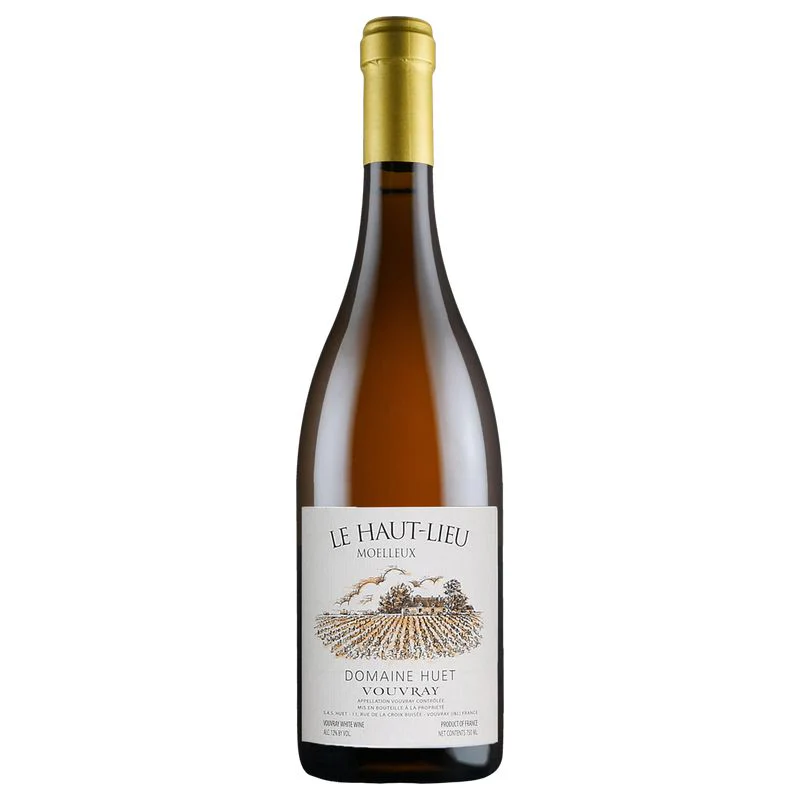
Domaine Huet Vouvray Le Haut-Lieu Moelleux 2003 (Museum Release)
Le Haut Lieu was the estate’s first vineyard, purchased in 1928, and is situated on the Première Côte. As the name suggests, the house and the vineyards are located on a plateau with a slight south-facing gradient at one of the highest points of the appellation. It’s a nine-hectare plot on deep, brown, chalky clay (known as aubuis). Here, the yellow limestone (tuffeau) bedrock lies up to four metres down, making for a richer soil that produces round, supple wines that tend to drink well young. It generally produces the earliest maturing of the three cuvées and the first ready for drinking, but, like Clos du Bourg and Le Mont, the wines can be extremely long-lived. We have enjoyed bottles from the ’40s that are still drinking very well!
Huet’s succulent moelleux wines (moelleux translates to ‘marrow-like’ and is pronounced ‘mweh-luh’) typically have between 40 and 60 g/L residual sugar. They are made mainly from grapes that have dried on the vine (passerillage) rather than those affected by botrytis. Huet’s moelleux wines can be remarkably fine and delicate—think of a great Mosel rather than a Sauternes for an idea of weight—and pair brilliantly with cheeses and a range of savoury meat dishes (only wines from the richest years work with fruit-based desserts).
Occasionally, in the top years, the sweeter première trie level is made from a berry-by-berry selection of the very ripest (often botrytis-affected) grapes. The balance is dumbfounding, and these mouthwatering, racy, transparent wines represent some of the greatest whites of France. The première trie wines can also work with desserts—but nothing too sweet (they’re better with cheeses).
Original: $153.11
-65%$153.11
$53.59Product Information
Product Information
Shipping & Returns
Shipping & Returns
Description
Le Haut Lieu was the estate’s first vineyard, purchased in 1928, and is situated on the Première Côte. As the name suggests, the house and the vineyards are located on a plateau with a slight south-facing gradient at one of the highest points of the appellation. It’s a nine-hectare plot on deep, brown, chalky clay (known as aubuis). Here, the yellow limestone (tuffeau) bedrock lies up to four metres down, making for a richer soil that produces round, supple wines that tend to drink well young. It generally produces the earliest maturing of the three cuvées and the first ready for drinking, but, like Clos du Bourg and Le Mont, the wines can be extremely long-lived. We have enjoyed bottles from the ’40s that are still drinking very well!
Huet’s succulent moelleux wines (moelleux translates to ‘marrow-like’ and is pronounced ‘mweh-luh’) typically have between 40 and 60 g/L residual sugar. They are made mainly from grapes that have dried on the vine (passerillage) rather than those affected by botrytis. Huet’s moelleux wines can be remarkably fine and delicate—think of a great Mosel rather than a Sauternes for an idea of weight—and pair brilliantly with cheeses and a range of savoury meat dishes (only wines from the richest years work with fruit-based desserts).
Occasionally, in the top years, the sweeter première trie level is made from a berry-by-berry selection of the very ripest (often botrytis-affected) grapes. The balance is dumbfounding, and these mouthwatering, racy, transparent wines represent some of the greatest whites of France. The première trie wines can also work with desserts—but nothing too sweet (they’re better with cheeses).